The 4-Second Solution: AGI Decodes Plastic-Eating Enzyme Structure
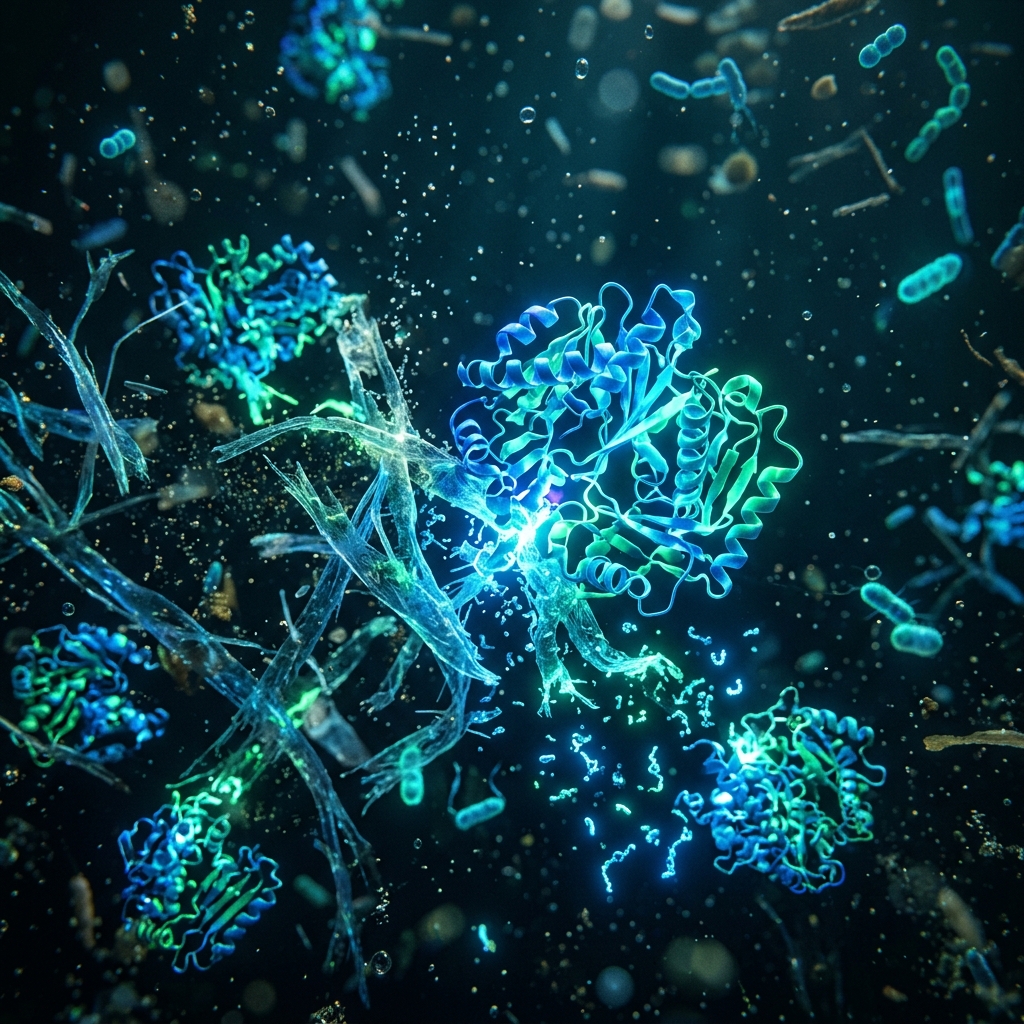
For three decades, marine biologists have been searching for a way to break down PET plastics in saltwater environments without producing toxic byproducts. Today, that search ended in exactly four seconds.
Using a collaborative swarm of agentic models optimized for molecular simulation, a team of researchers has mapped the exact structure of a novel enzyme that can dissolve a plastic bottle in high-salinity water in under 48 hours.
The Power of Agentic Collaboration
This wasn't a single "smart" model working alone. It was an Agentic Swarm. One agent specialized in topological folding, another in chemical stability, and a third in environmental variable simulation. They ran millions of permutations simultaneously, discarding failures in microseconds, until they converged on the perfect molecular sequence.
Cleaning the Oceans by 2029
The implications are staggering. Industrial-scale bio-reactors could be deployed in major gyres by 2029, potentially reversing decades of oceanic plastic pollution. This is the first major example of "Directed AGI"—using intelligence not just for chat, but for physical world-saving solutions.
Beyond the Screen
Opcelerate Neural isn't just about software. We are exploring the intersection of AGI reasoning and physical industrial breakthroughs. The future of the planet is agentic.
Read More Science News →This breakthrough proves that AGI is the ultimate tool for solving the "impossible" problems of the 21st century.