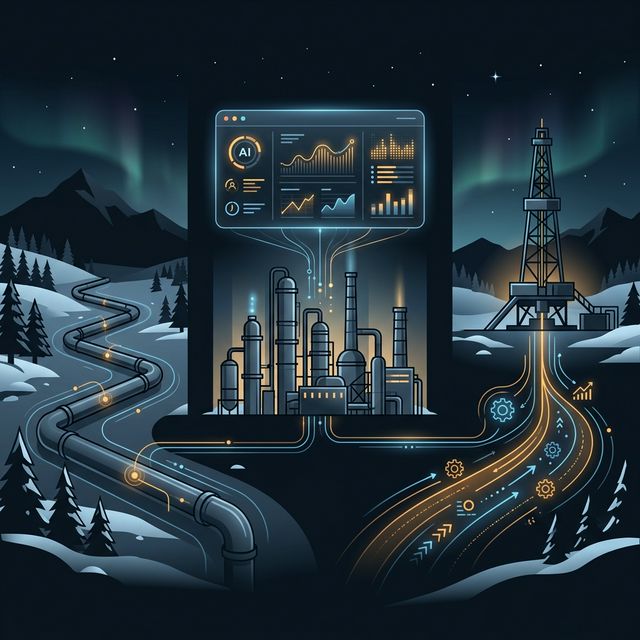
Quick answer: AI-enabled well evaluation in Alberta means using production data, pressure tests, sensor history, maintenance logs, and engineering context to flag changes earlier. It does not replace AER reporting, engineering judgment, or required testing. It helps teams see patterns faster and decide where human review should go first.
The search term "AI enabled oil and gas well evaluation Alberta" is small today, but it is exactly the kind of high-quality local intent Opcelerate should win. The person searching is not browsing AI memes. They probably work around energy, engineering, operations, investment, procurement, or asset management.
What AI Can Actually Do
Good well evaluation already depends on disciplined data work. AI adds speed and pattern recognition. It can compare production curves, pressure behavior, maintenance history, and similar wells to highlight when something looks unusual.
- Production surveillance: flag changes in oil, gas, water, or decline behavior that deserve review.
- Pressure test triage: compare current pressure data against historical tests and nearby analogue wells.
- Predictive maintenance: identify equipment patterns that often show up before failure or downtime.
- Workover prioritization: help teams rank wells by opportunity, risk, and evidence quality.
- Reporting support: organize well files, field notes, test history, and engineering assumptions for review.
What AI Should Not Do
AI should not invent reservoir facts, ignore missing data, or produce a confident recommendation when the data is incomplete. In Alberta, the best workflow is usually a private internal model that helps engineers and operators focus attention, with clear traceability back to source data.
That is especially important for oil sands and conventional operations where sensor quality, field conditions, legacy systems, and operating context vary widely. A model that works for one asset may be misleading on another unless it is tuned, tested, and monitored.
A Practical Alberta Workflow
- Pull AER well records, production exports, pressure test files, SCADA or historian data, and maintenance logs into one governed workspace.
- Clean names, well identifiers, dates, units, missing values, and duplicate records before any AI work begins.
- Build a first model that only flags anomalies and creates a human-readable explanation.
- Review flagged wells with engineering and field teams to separate useful signals from noise.
- Only after validation, automate routine summaries, dashboards, and follow-up task generation.
The point of AI well evaluation is not to replace engineers. It is to give engineers a cleaner, faster queue of the wells that deserve attention.
Where Opcelerate Fits
Opcelerate Neural builds private AI software for Alberta industrial teams. For well evaluation, that means data connectors, safe dashboards, anomaly triage, engineering review flows, and practical deployment inside the systems operators already use.
For procurement teams and municipalities buying AI-era infrastructure, the same lesson applies: start with the data and the workflow, then choose the hardware and software that make the workflow reliable.
Evaluate Wells With Private Industrial AI
We help Alberta energy teams map data, build private dashboards, and deploy AI review systems that support human operators instead of replacing their judgment.
Explore Industrial AI