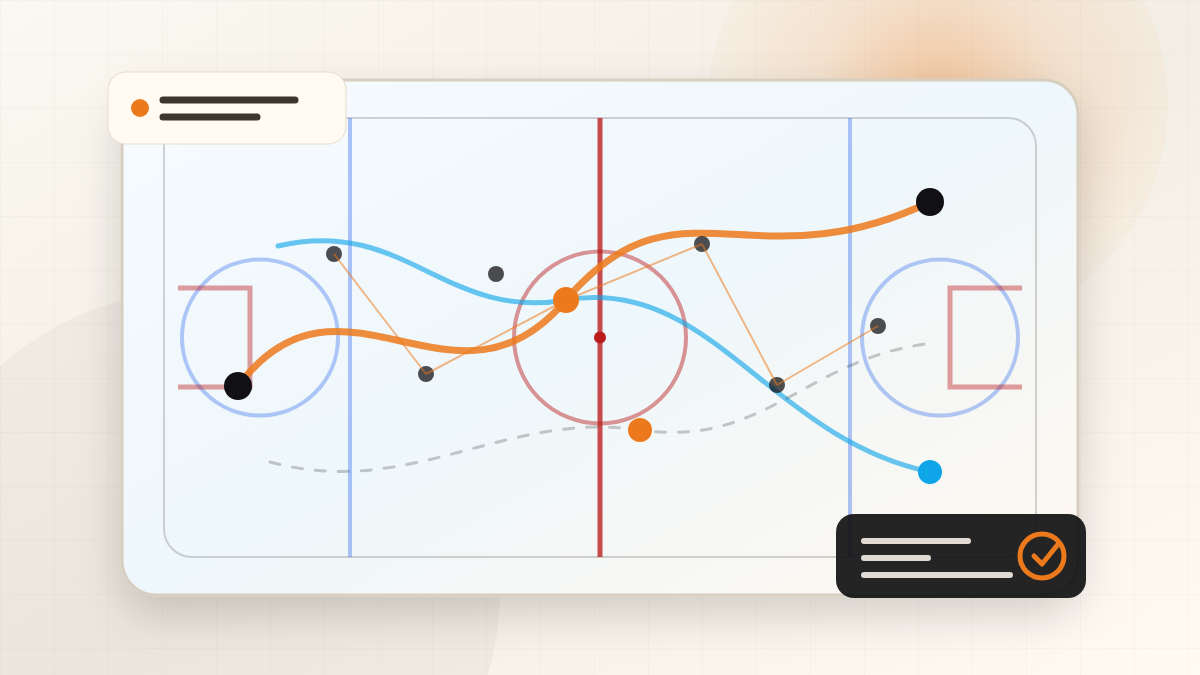
Quick answer: AI in hockey is already real. NHL EDGE turns puck and player tracking into public advanced stats, AWS powers broadcast analytics such as shot and save probability, and hockey analytics companies use computer vision to tag video, measure player movement, and support scouting. The best near-term use for Canadian teams is not replacing coaches. It is faster film review, cleaner scouting notes, practice feedback, and safer workload decisions.
Hockey is a perfect AI sport because the game is fast, fluid, and full of small decisions that are hard to see live. A winger's route through the neutral zone, a defender's gap control, a goalie set before a lateral pass, or a forecheck that forces a rushed breakout can decide the game before the scoreboard notices.
The AI opportunity is to capture those small patterns without asking coaches to watch every shift five times. The human still decides. The system just finds the clips, summarizes the patterns, and makes the next practice or scouting meeting sharper.
What Is Already Real
The Practical Hockey AI Stack
A Real Team Workflow
Imagine a junior or university hockey program in Alberta. After every game, the staff uploads video, shift charts, and notes. The AI does not pick the lineup. It prepares the room.
- Clip queue: 18 defensive-zone exits, 11 failed clears, 7 controlled entries against, and 5 high-danger rebound sequences.
- Pattern summary: the left-side breakout failed most often when the weak-side winger left early.
- Practice recommendation: run a 12-minute breakout reset drill with pressure arriving from F2, then review three clips before the drill.
- Scout note: the next opponent's second power-play unit prefers a low-to-high seam after the first retrieval.
Where AI Helps Most
| Hockey job | AI assist | Human decision | Risk guardrail |
|---|---|---|---|
| Coach | Find recurring play patterns and generate clip playlists | Choose what to teach and how to deliver it | No automated benching or player criticism |
| Scout | Summarize tendencies across video and tracking reports | Evaluate context, character, role fit, and projection | Do not reduce a player to one model score |
| Trainer | Track workload signals, fatigue patterns, and recovery flags | Assess health, readiness, and medical context | Medical decisions stay with qualified staff |
| Manager | Prepare travel, equipment, sponsorship, and ticketing reports | Approve budgets, staffing, and communication | Keep personal data permissioned and minimal |
What Canadian Teams Should Build First
The best first hockey AI project is not a giant custom model. It is a private searchable hockey brain: game video, practice notes, player development plans, scouting notes, travel templates, sponsor assets, and team policies in one controlled workspace.
That is useful for elite teams, but also for local organizations. A minor hockey association could summarize parent questions and scheduling conflicts. A junior team could improve scouting consistency. A rink operator could forecast ice demand. A sports academy could create better player development feedback without adding hours of admin work.
The Opcelerate Take
AI in hockey should feel like a great assistant coach: fast with film, precise with patterns, and humble enough to let humans lead. The opportunity for Canadian hockey is not to make the game robotic. It is to make preparation better, reduce avoidable admin, and give coaches more time with players.
Want A Sports AI Prototype?
Opcelerate Neural can map a private hockey analytics workflow: video tagging, player notes, scouting reports, sponsor operations, or team admin automation.
Map A Hockey AI Pilot