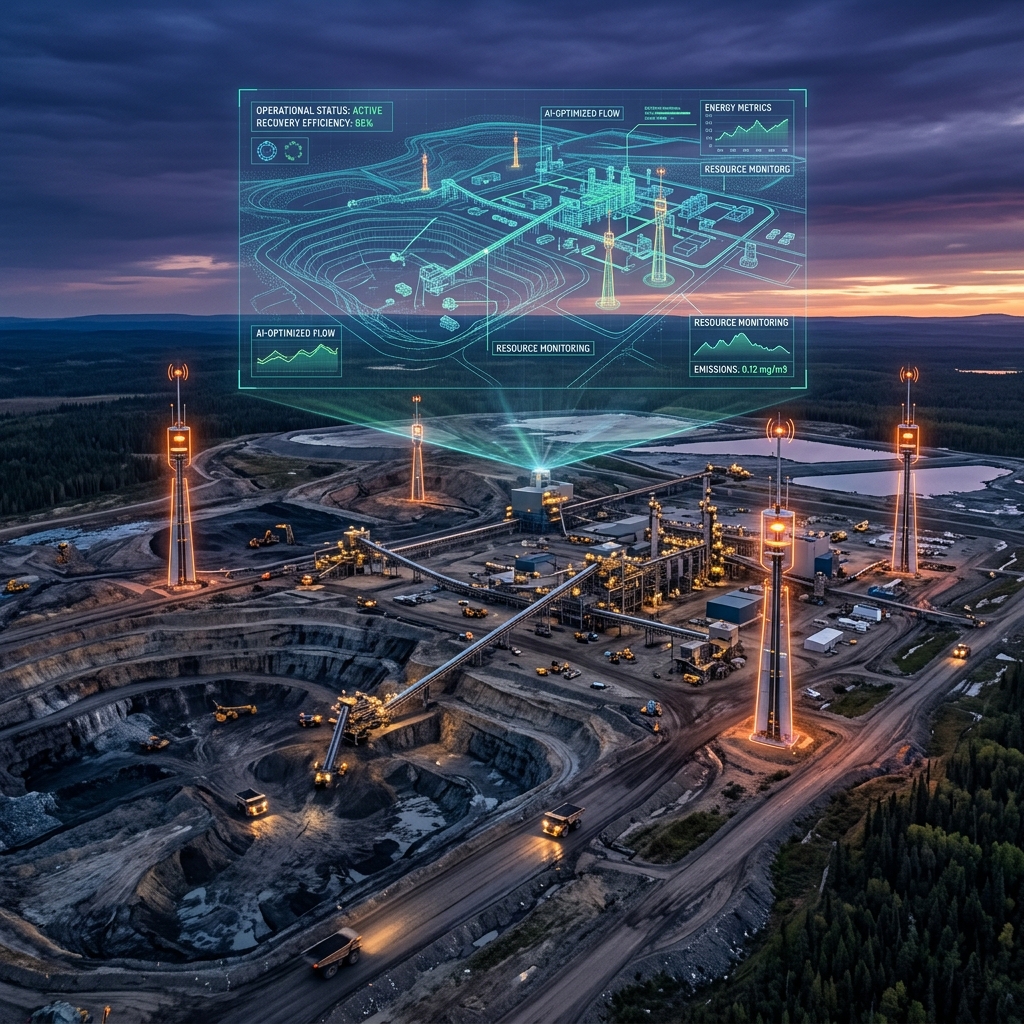
In what industry insiders are calling "the most dramatic return on AI investment in Canadian industrial history," a Suncor Energy AI digital twin system flagged a subsurface pipeline stress anomaly 48 hours before physical pressure sensors registered any abnormality — giving field crews enough time to execute a controlled shutdown, inspection, and repair that prevented what engineers calculate would have been a $40–60 million spill event and potential environmental emergency.
The system, developed in partnership with Edmonton-based industrial AI specialists, continuously processes data from 22,000 embedded sensors across Suncor's Fort McMurray facilities. It builds a real-time "digital twin" — a virtual replica of the entire operation — and uses predictive modeling to flag deviations from expected performance months before they become failures.
How the Digital Twin Caught What Sensors Missed
The specific anomaly was a micro-fracture forming in a pipeline elbow under a section of muskeg that had experienced unusual thermal expansion during a January cold snap. The fracture was too small to trigger pressure differential alarms — physical sensors measure end-state changes, not the structural conditions that lead to them.
The AI digital twin, by contrast, was monitoring 847 data variables simultaneously: soil temperature gradients, flow rate micro-variations, vibration patterns from adjacent pump stations, and historical failure records from similar pipeline geometries in comparable geological conditions. The convergence of multiple subtle signals — none individually alarming — produced a high-confidence failure prediction.
Alberta's Industrial AI Moment
The Suncor case is accelerating what Petroleum Services Association of Canada president David Pryce calls "a tipping point in Alberta's industrial AI adoption curve." At least six other major oilsands operators have contacted Suncor's technology partners requesting implementation timelines. The Alberta government's energy innovation office fast-tracked a $75 million AI infrastructure investment program announcement the same week.
"Alberta has always led Canada in energy innovation," said Premier Danielle Smith in a statement. "This is proof that the same spirit of innovation that built our energy sector is now driving the AI revolution that will keep it competitive for the next century."
Beyond Oil & Gas: The Industrial AI Spillover
The technology behind Suncor's digital twin is being adapted for applications across Alberta's industrial sector — from grain terminal monitoring in Lethbridge to water treatment facility management in Calgary. The underlying principle — continuous multi-variable monitoring with predictive failure modeling — applies anywhere physical infrastructure operates under stress.
Construction companies are using similar systems to monitor formwork stress during concrete pours. Pipeline inspection firms are deploying AI that analyzes drone footage and sensor data simultaneously. Even agricultural operations in the Peace Country are piloting AI systems that predict irrigation equipment failure before the growing season.
AI Predictive Maintenance for Alberta Industry
Opcelerate Neural helps Alberta's industrial businesses deploy AI monitoring and predictive maintenance systems. Free consultation — no obligation.
Get Your Free Assessment →The Suncor case has drawn international attention. A delegation from Norway's Equinor visited Fort McMurray last week to study the implementation. Saudi Aramco's technology division has requested a full technical briefing. Alberta may be sitting on the world's leading industrial AI deployment case study — and the economic spinoffs from licensing and consulting are just beginning to materialize.