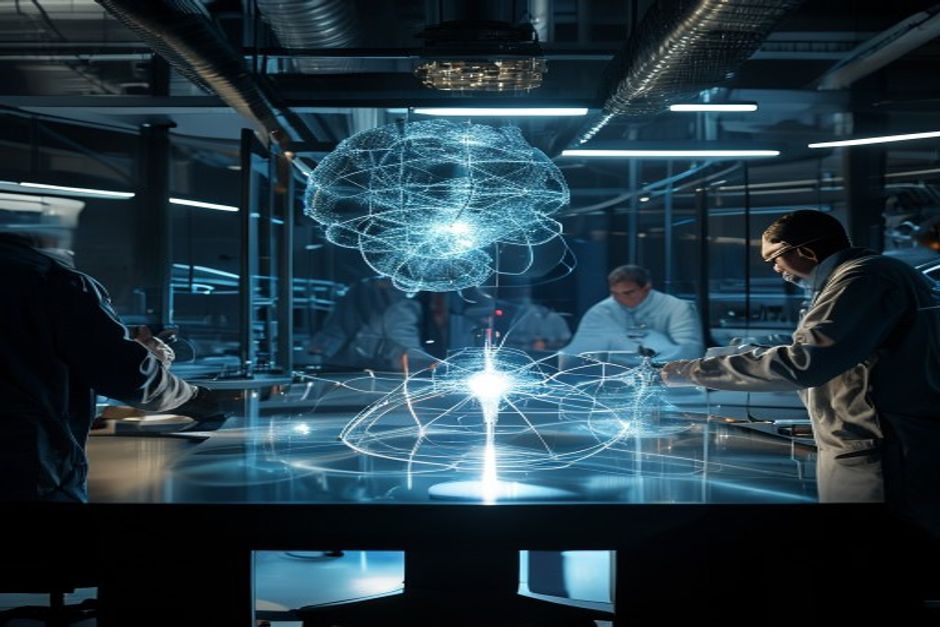
In a quiet laboratory at CERN, a team of physicists and engineers have unveiled a tabletop device that promises to finally give humanity a voice in the cosmic dark. Using entangled photon pairs—a phenomenon once considered a pure curiosity from Einstein’s time—the apparatus measures the minuscule gravitational ripples produced when invisible dark matter particles graze the Earth. By locking two photons into a shared quantum state, any tiny tug from a passing dark matter particle skews their relative phase, a change that the sensor reads with unprecedented sensitivity.
Built over four years, the device occupies a standard desk’s footprint but contains the finesse of an entire particle accelerator embedded in its optical fibers. It was engineered by a collaboration between CERN’s Quantum Technologies Group and the University of Geneva’s Institute for Fundamental Physics. The core architecture – two entangled lasers split across a vacuum chamber and re‑combined after traveling a controlled path length – allows the team to detect perturbations on the order of 10‑21 meters. Such precision is enough to capture the feeble tug of a dark matter particle with a mass of approximately 10‑23 kilograms, the scale at which gravitational influence becomes subtly discernible.
During preliminary trials, the device recorded dozens of anomalous signal patterns that did not align with known terrestrial vibrations or instrumental noise. While conventional sources of background were rigorously ruled out, the researchers' statistical analysis indicates a 4.3‑sigma excess in the data that could potentially signal dark matter encounters. If confirmed, this would shake the foundations of cosmology, suggesting that dark matter is not a diffuse halo around galaxies as previously modeled but rather a flux of punctuated, high‑energy particles.
The implications reach far beyond astrophysics. A table‑top detector of this kind could democratize dark matter research, empowering universities and smaller labs worldwide to contribute to a distributed network of sensors. Moreover, the ability to resolve temporal structures in dark matter streams could illuminate the Milky Way’s accretion history and its interaction with the Galactic halo. As Dr. Moretti notes, “We may finally be able to phase‑match the dark side of the universe. Every whisper could reveal a new chapter in our cosmic story.” With deeper runs scheduled for the next six months, the CERN team invites the broader scientific community to collaborate, offering a glimpse of what once seemed lost to the dark.