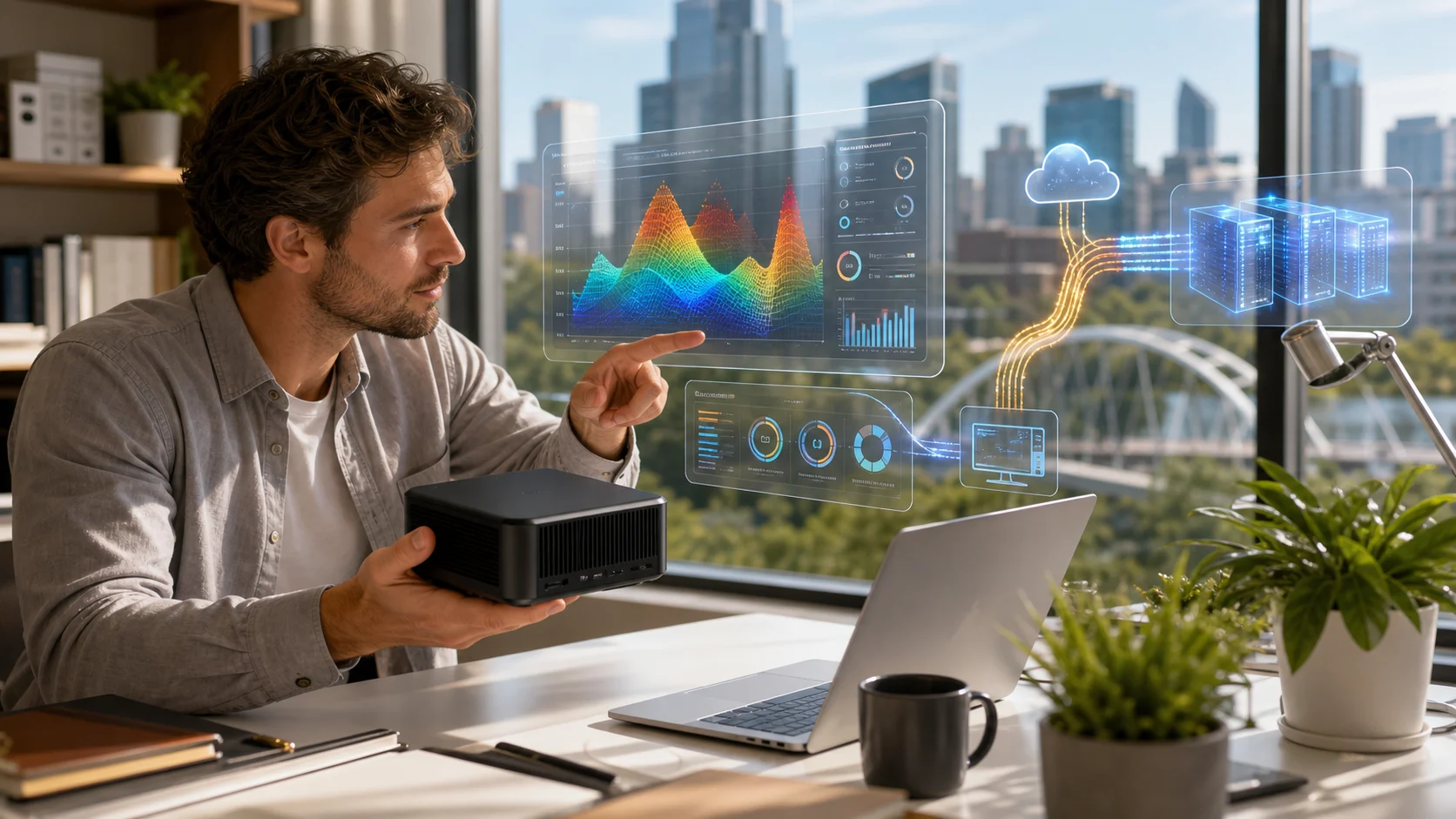
A viral post claims AMD put a giant local AI machine on a desk for the price of a lunchbox. The direction is real: AMD Ryzen AI Max+ 395 systems are making serious local AI experimentation more accessible. The numbers need discipline. A $1,499 GMKtec-style deal is commonly a 64GB configuration, while 128GB Ryzen AI Max+ machines show up closer to higher workstation pricing.
What Is Actually New
AMD lists the Ryzen AI Max+ 395 with Radeon 8060S graphics, 40 graphics cores, LPDDR5x-8000 support, and a maximum memory configuration of 128GB. AMD's Ryzen AI Halo developer platform page goes further and positions the 128GB unified-memory system as a compact local AI workstation for up to 200B-parameter model workflows.
That matters because local AI buyers are not only shopping for raw GPU speed. They are shopping for memory. Large models, long context, retrieval experiments, coding agents, document workflows, and private demos can hit memory limits before they hit pure compute limits.
The Viral Claim Needs A Buyer Footnote
The screenshot's most useful idea is that the desktop AI category is changing. The weakest part is the implied one-size-fits-all price and benchmark story. Public product pages and reviews show multiple configurations: GMKtec lists 64GB and 128GB EVO-X2 options, Notebookcheck reported the 128GB model above the entry price, and AMD's own Halo developer platform is positioned as a $3,999-class workstation in recent coverage.
So do not buy from a screenshot. Confirm the exact RAM amount, storage, operating system, cooling, return policy, software stack, model quantization, and benchmark prompt length. A 64GB system can be useful. It is not the same buyer decision as a 128GB local AI workstation.
Buyer Checklist
| Question | Why It Matters |
|---|---|
| Is it 64GB, 96GB, or 128GB? | Model size and context length depend heavily on available unified memory. |
| What model are you actually running? | A 7B, 70B, 200B, or quantized mixture-of-experts model has very different speed and memory needs. |
| Is this for private work or daily frontier reasoning? | Local hardware is strongest for privacy, demos, offline work, batch jobs, and repeatable internal workflows. |
| What is the fallback? | Cloud APIs still win for frontier capability, collaboration, uptime, and high-throughput team use. |
The Opcelerate Take
For Edmonton and Alberta operators, local AI hardware is not a toy category anymore. It is a practical middle layer between cloud subscriptions and data-centre infrastructure. The right question is not whether AMD "killed" NVIDIA. The right question is which work should stay on a private desk box, which work belongs in a governed cloud workflow, and which work still needs a managed vendor.
Opcelerate recommends a 30-day pilot before buying multiple machines. Pick one business workflow: confidential document review, local RAG over company files, coding-agent experiments, tender analysis, customer-service drafts, or internal training. Measure setup time, model quality, speed, privacy requirements, maintenance time, and whether staff actually use it.
Action Plan For Teams
Start with the workload, not the headline. If the job is sensitive, repetitive, and can tolerate slower local inference, a Ryzen AI Max+ class machine can be worth testing. If the job needs the best reasoning model available today, team sharing, audit logs, and uptime guarantees, keep the cloud path. The winning stack will often be hybrid: local for private drafts and experiments, cloud for frontier reasoning and production-grade services.
Teach Yourself: Read These First
- AMD Ryzen AI Max+ 395 product page - Check the official CPU, graphics, and maximum memory specifications.
- AMD Ryzen AI Halo for developers - Read AMD's positioning for compact local AI development systems.
- Framework Desktop with Ryzen AI Max - Compare real 64GB and 128GB configurations.
- GMKtec EVO-X2 product page - Verify configuration and price before repeating viral deal math.
- Notebookcheck EVO-X2 review - Useful independent context on pricing and configuration differences.
