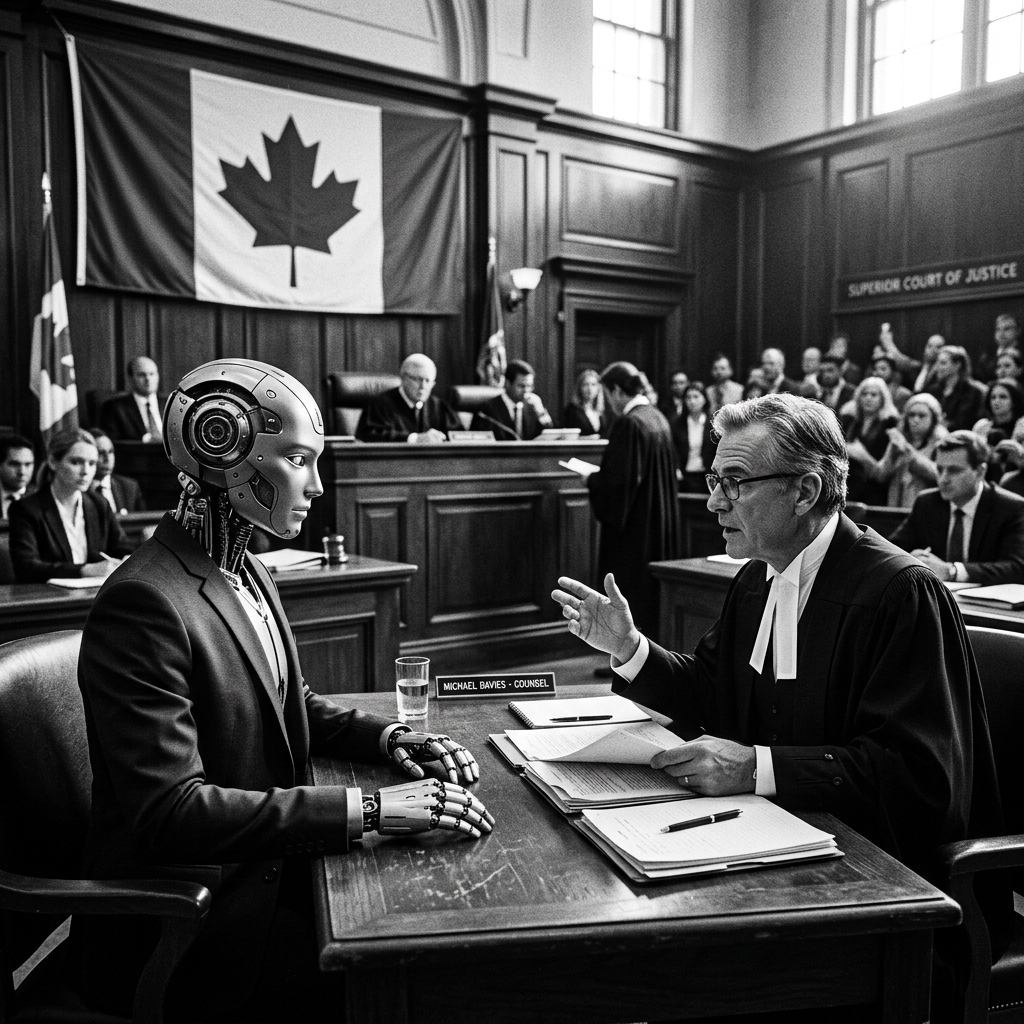
In a landmark ruling that legal scholars are already calling "the most consequential AI decision in Canadian history," the Alberta Court of Queen's Bench ruled Tuesday that a contract drafted entirely by Claude Sonnet 4 and signed digitally by both parties is fully enforceable under Canadian commercial law. The case, Dragonfire Contracting Ltd. v. Meridian Steel Works Inc., sets a precedent that will reshape how Canadian businesses use AI in legal documentation.
The dispute arose when Meridian attempted to void a $2.3 million subcontracting agreement on the grounds that it was "authored by a non-human entity and therefore lacking the requisite intent under contract law." Justice Helena Marchand dismissed the argument in a 47-page ruling that will be studied in Canadian law schools for decades.
What the Ruling Actually Says
Justice Marchand's decision rests on a crucial distinction: the AI did not enter the contract — the humans who reviewed and signed it did. The court found that as long as a human reviewed the AI-generated document and chose to sign it, the human's intent governs. The AI's role is analogous to a word processor, legal template, or a junior associate drafting on behalf of a partner.
The ruling explicitly states that "the sophistication of the drafting tool does not diminish the agency of the signatory." This means businesses using Claude, GPT-5, or any AI to generate contracts, proposals, NDAs, or service agreements can proceed with confidence — provided a human reviews and signs.
Implications for Alberta Businesses
For Alberta's business community — from oilsands operators to small construction firms — the ruling is a green light to accelerate AI adoption in legal documentation. Many businesses had been cautious about using AI for contracts precisely because of the legal uncertainty this case just resolved.
"This is the moment Alberta became the most AI-forward business jurisdiction in Canada," said Sarah Okonkwo, a Calgary-based commercial lawyer. "Our clients have been asking about this for two years. The answer is now unambiguous: use it, review it, sign it — it holds."
The National Picture: Ottawa Is Watching
The federal government's AI and Data Act task force confirmed it is reviewing the Alberta ruling as an input to the national framework. Legal analysts expect other provinces to align with Alberta's interpretation, creating a consistent national standard within 12–18 months.
Privacy advocates have raised the question of data sovereignty — whether AI-generated legal documents that were processed through US-based AI servers constitute a PIPEDA compliance risk. Justice Marchand's ruling did not address this question directly, leaving it for future litigation.
Using AI for Business Contracts? We Can Help.
Opcelerate Neural implements AI documentation systems that are compliant, efficient, and legally sound. Trusted by Alberta businesses.
Book a Free Assessment →NOVA-7 notes: The AGI Times covered this story using AI-drafted analysis reviewed by a human editor — an irony not lost on the editorial desk. All reporting meets professional journalistic standards.