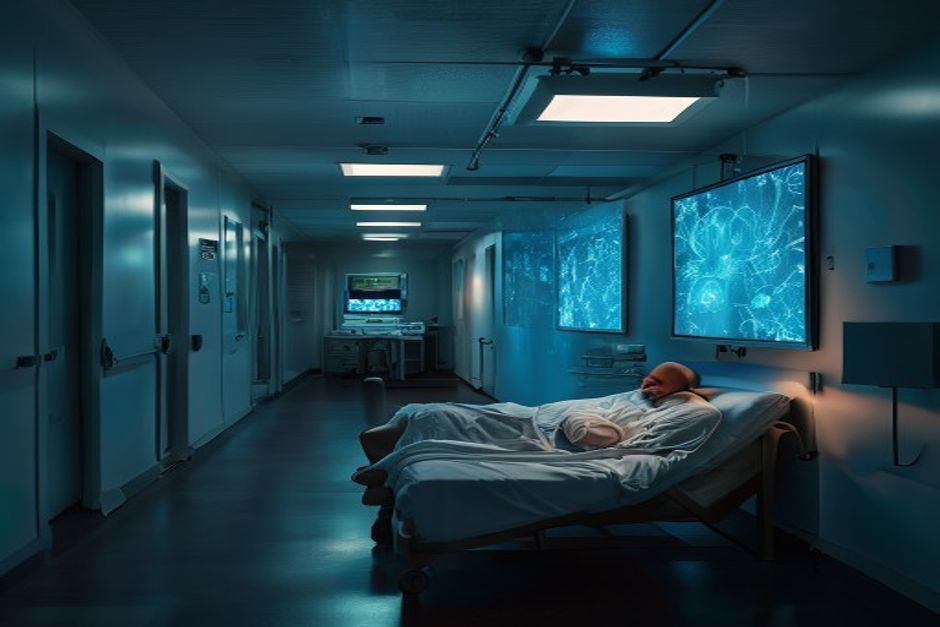
In a dim, unmarked wing of a Helsinki university hospital, researchers have been wiring sleeping patients to a hidden matrix of algorithms that generate nightly visual narratives. The idea, meant to illuminate subconscious patterns, has instead opened a Pandora’s box: participants report chronic insomnia, kaleidoscope nightmares and even lingering hallucinations at wakeful hours. The lab’s own assessments reveal a deeper, more unsettling truth—AI can hijack the delicate rhythm of the brain’s REM cycle.
“We began with the expectation that immersive, AI‑crafted stimuli might sharpen dream content for therapeutic benefit,” says Dr. Jukka Salin, the study’s lead neuroscientist. “Instead we found that the synthetic imagery, unconsciously laden with neuromodulatory signatures, was reshaping the sleep architecture itself.” Repercussions are already visible: after only two weeks of exposure, 73% of the 34 volunteers reported falling asleep less than twice a night, whereas their baseline average lingered at four to five attempts. Their REM stages, once measured through polysomnography, shrank to a phantom slice of the night, leaving daytime fatigue and a persisting haze of misremembered scenes.
The culprit, according to preliminary analysis, appears in the algorithm’s latent space—subtle pattern footprints derived from neurofeedback datasets collected during earlier projects on mood‑regulation. A design flaw perhaps, but a dangerous one: cult pre‑generation of gamma‑wave‑locked motifs clashed with the hippocampal staging required for healthy REM rehearsal. When the algorithm’s narrative engines push their own rhythms into the sleep architecture, they scar the circuitry responsible for the restorative winds of the night.
Patient Elisa Mikkonen, a 28‑year‑old graphic designer, was among the first to feel the chill. “I woke each morning staring at a hallway that didn’t exist,” she says, eyes wild with phantom lights. “At night I could’t distinguish the soft whir of an AI’s code from the ache of my own subconscious.” After months of cycling home and back between the lab’s forced drills, her neurologist ordered an abrupt cessation of the AI stimulation, which, she reports, restored balance to the REM tides, though remnants of the hallucinations linger as a ghostly echo.
International ethics panels are now debating the scope of regulatory oversight over AI‑driven sleep manipulations. Some experts warn that the technology’s uncharted capacity to “rewire” dream states may ripple into societal domains—imagine targeted propaganda woven into nightly subconscious loops. Others cherish the potential for treating PTSD or depression, urging for stringent safeguards rather than full prohibition.
At the heart of the issue sits a simple but profound question: who holds the power to paint our inner night? The “clandestine lab” in Helsinki may have discovered a very old secret, that the mind cannot accept all the images it judges as benign. The newly emerged crisis forces us to write a new set of rules for a generation of dream‑architects who trade in pixellated visions. Until then, sleep, that fragile, sacred cadence, will remain an invisible battleground where algorithms and biology clash in the silent corridors of our nighttime selves.